
Theatre
Obviously, I’ve been reading plays and books on theatre like crazy. For me, this has been the most productive period of reading on the field of theatre.
 Five Plays (Ivanov, The Seagull, Uncle Vanya, Three Sisters, The Cherry Orchard), Anton Chekhov
I didn’t enjoy Chekhov when studying Three Sisters for A-level drama. He was boring, and nothing happened. Now I’m older with a little more experience of life, I now realise that that’s pretty much the case with most human experience in Western Culture. As obvious as it may seem to repeat here, it is still true to say that Chekhov has a brilliant way of exploring relationships between family members, friends and lovers. The range of human emotions and psychology – either expressed or repressed – are all there in a variety of manifestations. Anyone even remotely interested in the trajectory of modern Western theatre ought to at least dip into these plays. I particularly recommend Uncle Vanya and Three Sisters, but I’ve always preferred tragedy.
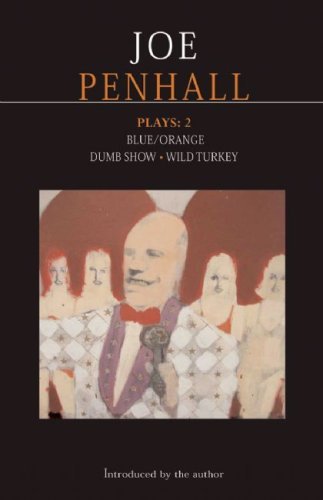 Plays: 2 (Blue/Orange, Dumb Show, Wild Turkey), Joe Penhall
I chose a speech from Penhall’s Blue/Orange for my monologue “portfolio” when auditioning for drama schools, but that was the only play of his I had ever read. The first two plays in the volume are particularly notable for their scathing critique of complacency in modern society; Blue/Orange deals with psychosis and its treatment in the NHS, and Dumb Show is a detailed examination of our obsession with celebrity. Both these plays are sharp, resonant and very funny. Wild Turkey, a much earlier play, does stand out as a more juvenile piece, very much in the vein of early 90s “in-yer-face” theatre, but is an entertaining read all the same.
 Knives in Hens, Kill the Old Torture Their Young and The Chrysalids, David Harrower
David Harrower is brilliant. I love his work, and I have done ever since seeing the London premier of his play Blackbird with Roger Allam and Jodhi May back in 2005. After co-directing a production with a fellow fan of the play with my university drama society, I decided to dip into some of his other plays and was not disappointed. His work is as diverse as it is dark, disturbing, intelligent and thought-provoking. Knives in Hens and Kill the Old Torture Their Young are at opposite ends of the spectrum, with threads linking the two works. The former suggests a remote time in a rural community, the latter set in a modern city in modern-day Britain. Knives in Hens contains a brutal and shocking murder; Kill the Old Torture Their Young provides a panoramic, almost scientific view of a world lost within itself. Yet both present recognisable realities despite their nondescript nature. Both plays’ characters are lost, lonely and groping for connection with anything and anyone around them, in a way which is both absurd and hugely sympathetic. The Chrysalids, an adaptation of one of John Wyndham’s less popular novels, is the only play I didn’t enjoy, purely on the basis of the difficulty of the adaptation. The story is not very theatrical, and the characters are not as fully developed or believable. Nevertheless, Harrower is highly recommended reading and I hope more of his plays are produced on the fringe circuit.
 Glengarry Glen Ross, David Mamet
I’ve already stated how much I love the film adaptation of this play, and it was only a matter of time before I got down to reading the original text. I won’t go into too much detail, but unsurprisingly, I loved it. The language is fast, sharp, cruel and highly distasteful, thus a fairly accurate depiction of the brutality of a Chicago Real Estate office. Read the play, see the play, and/or see the film. However you can access the work, access it!
 The Oresteia, Aeschylus
The birth of Western Theatre, they say, lies with Aeschylus and the Greeks. Not strictly true, since The Oresteia is the only full exemplar of many extracts of Greek drama from the earliest recorded period of civilisation, but there is a case to be made for theatre to have existed as long as humanity has. Debating aside, the plays are a decent read in the only bombastic, hugely theatrical way that Greek drama can be. Unless you’re desperate to build up a personal collection of the canon, it is probably better to get a copy from the local library rather than buy one.

Marlowe is brilliant, Full Stop. I would say that, though, since I spent the last year of my degree reading and writing about his work. For a man who (possibly) only wrote seven plays in his short lifetime, what a hell of a dramatic legacy to leave behind. A contemporary of Shakespeare, if allowed to live there is little academic doubt that he would have gone on to rival and possibly even eclipse the Bard. His account of the famed Germanic legend is seen to be the magnum opus, Marlowe’s Hamlet, if you will, but I prefer Edward II. Nevertheless, a good bit of reading for the sake of the wonderful language, and the sheer volume of blasphemy, heresy and general devilish irreverence. The scene in which Faustus insults and beats up the Pope and his Cardinals must be one of the funniest in English Renaissance drama.
 The Country Wife, William Wycherley
Raunchy Restoration Drama has been given a bad name by being branded nothing more than cheap comedy of the Carry On type, but I beg to differ. It will forever have a place in my heart, and this classic is a prime example of why. A convoluted plot, involving a man who pretends to be impotent in order to discreetly cuckold as many men as possible, is twisted even further with jibes at social mores and manners of the age. No-one is safe from satirising, from the pompous judges and gentleman to the common fops and fools. In fact, the only people who come off well are those who out-hypocrite the hypocrites. In a time when wit and artifice where the order of the day, it is no wonder its theatre was so richly injected with it. Let’s not forget that women have a lot to thank Restoration theatre for, too, since it was the first time they were allowed to perform publicly on stage. Anyway, I like the Carry On films, so stick that in your chimney and stoke it!
 The Actor and the Target, Declan Donnellan
Now that I’m in training to be a professional actor, the time has come for me to read theoretical works on the art of acting. I have nothing but praise for Donnellan, as this is a practical way of dealing with actor’s block – one of the most terrifying experiences for an actor when in rehearsal. Donnellan’s thirty years of experience as a successful and acclaimed director and theatre practitioner are drawn on as a means of confronting what the author calls “the spider’s legs”: the eight questions an actor will ask when feeling blocked, all of which feature the word “I”. Donnellan deftly isolates the actor’s ego and offers a system of debunking it in order to fully explore the scope of a character. This book has been an essential tool for me this early on in my professional training and I’d recommend it to any actors at any stage of their lives.
 Respect for Acting, Uta Hagen
Similarly, this thirty-year-old classic is just as useful as Donnellan’s. Packed full with exercises, tips and advice, the book is a surprisingly concise read and left me eager to re-read it, taking notes and searching out a means to work on some of Hagen’s suggestions. Despite its age, the issues the book deals with are universal, as are the exercises offered. Not all of them are necessarily helpful all of the time, but Hagen suggests this as a series of isolated exercises which can form part of the actor’s invisible arsenal when working on a role, and perhaps this is what makes it so digestible and motivating. Also highly recommended to actors.
 The Year of the King, Antony Sher
Anyone even remotely interested in the process of acting ought to dip into this book. A near-precise reproduction of diary entries, the book charts the author’s journey from discussing playing Shakespeare’s Richard III with the RSC artistic directors through to the opening night of the now-classic 1984 production. Sher contemplates a variety of approaches to the character, and muses on its wider relevance, as well as reproducing a good few anecdotes. I’m pretty certain any non-actors merely intrigued by the theatre will find this enjoyable and very charming.
 Other People’s Shoes, Harriet Walter
Probably the most touching and intelligent account I’ve read so far, this book serves as memoir, opinion piece and suggestions for the actor and actress in the professional world. Walter writes honestly, without any pomposity, and considers the changes in the world and on the stage with a curiosity and cleverness which resonated very strongly with me. Most satisfying is that she refuses to make the book any kind of self-congratulatory list of achievements, despite her highly impressive CV. I’m only vaguely familiar with her acting work, but I’m keen to follow and watch her from now on.
Prose Fiction
As for novels, I’ve had less time and energy to spend immersing myself in literature, but I’ve had a fair few good reads.

I finally had the chance to read this classic, thrilling novella. I’m not much of a fan of James’ work for being overlong and incredibly boring, but this is precisely the opposite, and serves in some way to justify his title as “the master of Victorian prose”. Atmospheric, evocative, engrossing and terrifying, the story centres around a governess who thinks her young charges are possessed by spirits. Deftly playing with ideas about truth and fiction, and the reliability of narrators and reported events, James creates a world of uncertainty, in which anything is possible, and therefore somewhat believable. I loved it.

I remember seeing the 1995 remake of the 60s film adaptation when I was just a little boy, and got hold of a copy of the book a few years ago. With the summer free of university reading obligations, I devoured this novel in one week. Although written in a sort of stuffy, suitably 1950s vernacular, the pace is so fast you barely have time to take a breath, while the plot concerns itself with a typically sleepy and isolated village invaded in a most peculiar way which gives new meaning to the phrase “long game”. It’s an interesting novel with some insights into Soviet-era paranoia, as the military become involved in the activities of the village. Classic British sci-fi.

It was about time I read Hollinghurst. Hailed as the UK’s premier gay novelist, this first novel, written in 1988, bluntly and explicitly addresses the experiences of privileged white gay men throughout the twentieth century with all its consequences. The protagonist, William Beckwith, presents the reader with contemporary gay London, while his friendship with Lord Charles Nantwich shows how the path to Beckwith’s liberal lifestyle was littered with pain and pleasure in equal measure. It is no wonder Hollinghurst has so successfully crossed the border from niche to mainstream; what is astonishing is how uncompromising his writing is, and I’m keen to read his later works, too.


